A few days ago, the Wall Street Journal ran an article, Focused Funds Find Less Can Be More, highlighting the value of a concentrated investment strategy. It is a good, short article on the topic, but it misses an important point about diversification. The author writes, “Diversification is a tested way to control risk – a stock that represents 1% or less of a portfolio can’t inflict as much damage as a 5% position. Diversification’s downside is that it limits a fund’s chance to meaningfully outperform its index. Moreover, an overly diversified portfolio can mimic an index fund, but at a much higher cost.” The second and third sentences are certainly true, but the first leaves something to be desired.
It is mathematically correct that if a 1% position goes to zero the overall portfolio only loses 1% of value, whereas a 5% position could cause a 5% loss of portfolio value. However, a 100 stock portfolio may only be more diversified than a 20 stock portfolio in the number of company names it holds, as opposed to diversified from true risks. It comes down to what you are trying to diversify and why. Imagine recognizing in early 2008 that the financial sector was overvalued and significantly over-leveraged. If you built a 20 stock portfolio with no financial sector exposure based on this belief, your 20 stock portfolio would have significantly outperformed the 500 stock S&P500 index during 2008. True risk would have been diversified away.
Thinking about investment diversification based on number of investments alone is a mental crutch and a poor risk-management tool. One needs to look at a broad spectrum of potential economic factor risks (i.e. risks that can truly impact the intrinsic value of the security you own), as well as market risks and diversify exposure to the most likely and the most potentially harmful. A few examples of what we would consider relevant risks to diversify are: capital structure, inflation sensitivity, supplier, consumer, and legislative exposures.
Many fixed income investors are familiar with the concept of duration. It generally represents the change in the value of a bond that results from a 1% change in interest rates. If interest rates go up by 1%, a bond currently priced at par (100) with a duration of 5 will go down in value by 5 to 95. Check out Investor Words for a more detailed discussion.
Before we dig deeper into the application of duration to equities other than bonds, we need to take a brief digression for a quick refresher on asset valuation. In a pure sense, investments are worth the net present value of all of the future cash flows the investment will provide. The net present value is calculated by discounting each of the individual cash flows back to today using some interest rate. If my discount rate (or interest rate) is 5% and I am going to get $100 tomorrow, what is that investment worth to me today? $95.24. Here’s the math: $100/((1.00+5%)^1). So, we can think about duration as the impact of changing the discount rate we use to calculate the net present value of an asset’s future cash flows.
With that background, let’s take a look at how duration applies to equities. Equity investments have a much longer duration than fixed income investments because there is no set date for a return of principal. An equity investment’s dividends could continue to grow and pay ad infinitum. Therefore, equity investments are much more sensitive than fixed income investments to changes in the discount rate (i.e. the interest rate as described above). Within equities, a stock that pays a very high dividend and whose price implies little growth (e.g. Altria, MO) will have a much lower duration than an equity that pays no dividend and whose price implies substantial growth (e.g. Google, GOOG).
As we articulate in our most recent quarterly letter, we believe the current economic environment has the potential to leave corporate earnings volatile for some time and to increase the volatility of inflation, both of which could lead investors to increase their discount rate. So, all things being equal we believe equity investments that pay high dividends compared to those that pay no dividends and whose prices imply very high growth will outperform the overall stock market.
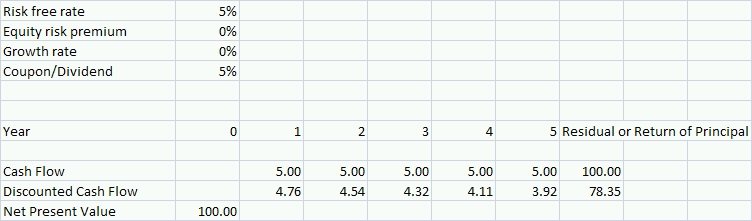
To illustrate why the duration on an equity is much higher than that on a bond, let us look at a couple of examples. First, assume we are talking about a Treasury bond with a 5% coupon and 5 years until the bond matures. Also, assume that the risk-free interest rate is currently 5%. As illustrated in the table below, the net present value of that bond is 100. We get to this value by discounting the bond’s annual coupons and the final return of capital at the risk-free rate.
Basic Bond Example
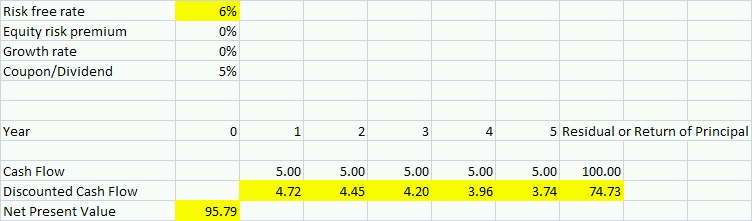
Now suppose we purchase that bond for 100. Immediately, new economic news comes out and the risk-free interest rate moves to 6%. How much is our bond now worth? The answer is 95.79(1). The following table illustrates the changes in the value of the discounted cash flows based on the new 6% discount rate, as opposed to the old 5% discount rate.
Bond Example with Increased Interest Rate
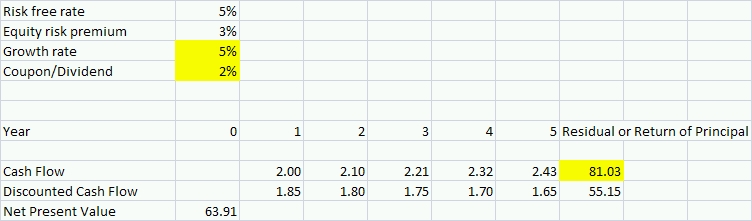
Now that we have seen why a change in interest rates changes the value of a bond, we turn to an example of an equity. Below, we model an equity investment that pays a 2% dividend which we think will grow at 3%. The risk-free rate is back to 5%, but now we add in a 3% equity risk premium. The net present value calculation tells us that an investment with these characteristics is worth 63.91. Notice that the cash flow for the residual value is highlighted. Unlike a bond, an equity investor is not promised a return of principal. The residual value of the equity that exists beyond the 5 year period we have chosen to model is just the present value of the future dividend stream that we can expect a new investor to pay. (The formula for the residual is a perpetuity: dividend/(discount rate – growth rate).)
Basic Equity Example
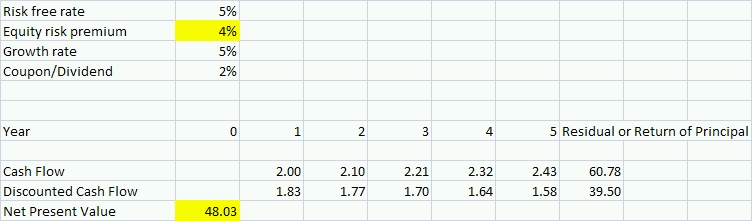
Rather than change the risk-free rate, we increase the equity risk premium in the final example below to demonstrate that an equity investment with these characteristics has a duration of almost 25. A 1% increase in the equity risk premium changes the net present value of the investment to 48.03. (48.03 is 25% below 63.91.) Notice how sensitive the value of an equity investment can be to the discount rate. Valuing an equity investment is a very imprecise process which is why it is important to have a very large margin of safety (i.e. an undervalued asset) before making an investment.
Equity Example with Increased Risk Premium
In conclusion, we believe the concept of duration is just as relevant when thinking about equity investments as it is when thinking about interest rate risk and fixed income investments. For a more detailed analysis of the impact inflation has had on the equity risk premium, review Ed Easterling’s work here. For further reading on equity duration, both Ben Inker of GMO and John Hussman of the eponymous Hussman Funds have explored this concept as it applies to the overall stock market. Their analysis is worth reviewing. If you would like to play along at home, you can download the spreadsheet model we used in this analysis here.
1 Careful readers will note that the 1% interest rate increase led to a 4.21% decrease in the value of the bond, NOT a 5% decrease. This is because a 5-year, 5% coupon bond has a duration that is slightly less than 5. A zero-coupon, 5-year bond would have a duration of exactly 5. This is because as an investor receives each coupon, that portion of the value is no longer subject to the new interest rate.